
Back to Latest Briefings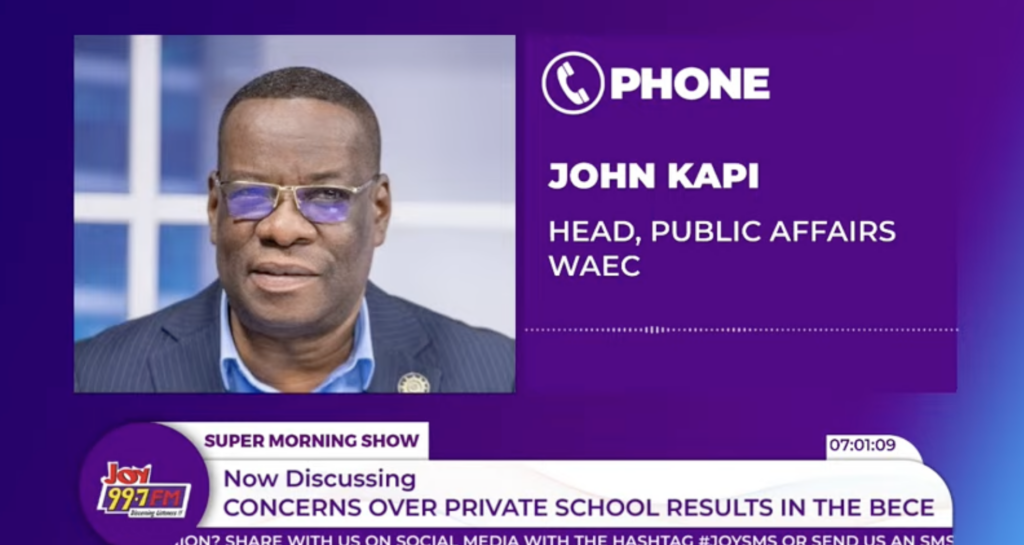


August 5, 2026
AI-Enhanced
WAEC asks schools to submit evidence of alleged BECE result discrepancies
Policy
Growth
Key Points
- WAEC has urged schools and parents to provide evidence for concerns regarding the 2026 Basic Education Certificate Examination (BECE) results.
- The appeal follows allegations from the Ghana National Association of Private Schools (GNAPS) about candidates receiving grades for subjects they didn't register for or inaccurate results.
- WAEC Head of Public Affairs, John Kapi, stated the Council requires documentary evidence to investigate specific claims, as they cannot act on unverified allegations.
- Kapi acknowledged that WAEC does not claim infallibility and publishes results as provisional to allow for investigation and correction of genuine errors.
- WAEC encourages affected schools and candidates to utilize established review procedures and is preparing a public statement on examination and results-processing procedures.
Why This Matters
The integrity of the BECE results is critical for the academic progression and future opportunities of thousands of Ghanaian students. Unreliable examination outcomes can erode public trust in the national education system and potentially hinder fair access to secondary education. Ensuring accuracy is paramount for maintaining educational standards and equity in Ghana.
Read Full Article
View original sourceRelated Articles
November 3, 2026
GCCE and WDI hold stakeholder consultations on financing Ghana’s electric two-wheeler industry
- The Ghana Chamber of Clean Energy (GCCE) and William Davidson Institute (WDI) held a workshop in Accra to address financing constraints for Ghana's electric two-wheeler sector.
- The event convened enterprises, financial institutions, and stakeholders to validate financing gaps and explore policy solutions.
- Identified financing challenges include limited import duty waiver implementation, difficulties transitioning from grants, reliance on company balance sheets, limited access to affordable local-currency debt, stringent lending requirements, equity investor preferences, and information gaps.
- GCCE emphasized the need for appropriate financing structures, stronger institutional collaboration, and an enabling environment to accelerate electric two-wheeler adoption.
- Workshop findings and recommendations will inform a forthcoming public report to guide GCCE's advocacy for policy and financing measures to support the sector's growth.
November 3, 2026
Ghana must reduce the cost of politics to curb influence of wealthy financiers – Development Economist
- Dr. Valentin Kwasi Mensah calls for reforms to curb the rising cost of political competition in Ghana.
- He warns that excessive campaign spending fosters politicians' dependence on wealthy financiers, who expect rewards like appointments or contracts.
- Research indicates a 59% increase in parliamentary campaign costs between 2012 and 2016, a trend exacerbated by poor enforcement of existing disclosure laws.
- Dr. Mensah recounts the Electoral Commission's failure to provide requested financial statements from major political parties despite constitutional and legislative mandates.
- He proposes establishing an independent regulator, campaign expenditure limits, timely donation disclosure, stronger enforcement, and improved internal party democracy.
November 3, 2026
8% pay rise: Workers will be better off in real terms— Dr Acheampong
- Public sector workers in Ghana are projected to experience real income improvements due to easing inflation preserving their purchasing power.
- Dr. Theo Acheampong of the Ministry of Finance stresses that the true measure of a salary adjustment is its real value after accounting for inflation, not just the nominal percentage.
- Historical data shows that in several past years, inflation significantly outpaced wage adjustments, leading to a decline in workers' real incomes.
- The trend is expected to reverse from 2025 onwards, with projected moderate inflation rates allowing for real wage gains despite seemingly lower nominal increases.
- The government's strategy focuses on sustainable wage adjustments coupled with inflation control to ensure workers' ability to meet their needs effectively.